An assessment doesn't judge people.
It shows where ownership gets stuck.
Validated assessments that map ownership behaviour, team dynamics and growth potential. Not a verdict on who is good enough, but data on what your organisation allows today.
Book a conversation
Where impressions fall short.
You make decisions about people based on impressions, and impressions can't be compared across teams. If you recognise two or more of the situations below, you don't have a people problem but a measurement problem.
You doubt whether someone can handle the role, but you can't name what exactly is missing.
Without a shared language, a people decision becomes a gut feeling with a job title attached.
Two teams with the same brief perform completely differently, and nobody knows why.
A team assessment exposes the difference where it lies: in agreements and room to decide, not in personalities.
Your development budget goes to training that anyone can sign up for.
Development without measurement is spreading it thin. What you don't measure, you can't target.
After the reorganisation everyone sits in a new chair, but the old behaviour stayed.
Moving people changes the org chart. Whether behaviour moves with it, you only know once you measure it.
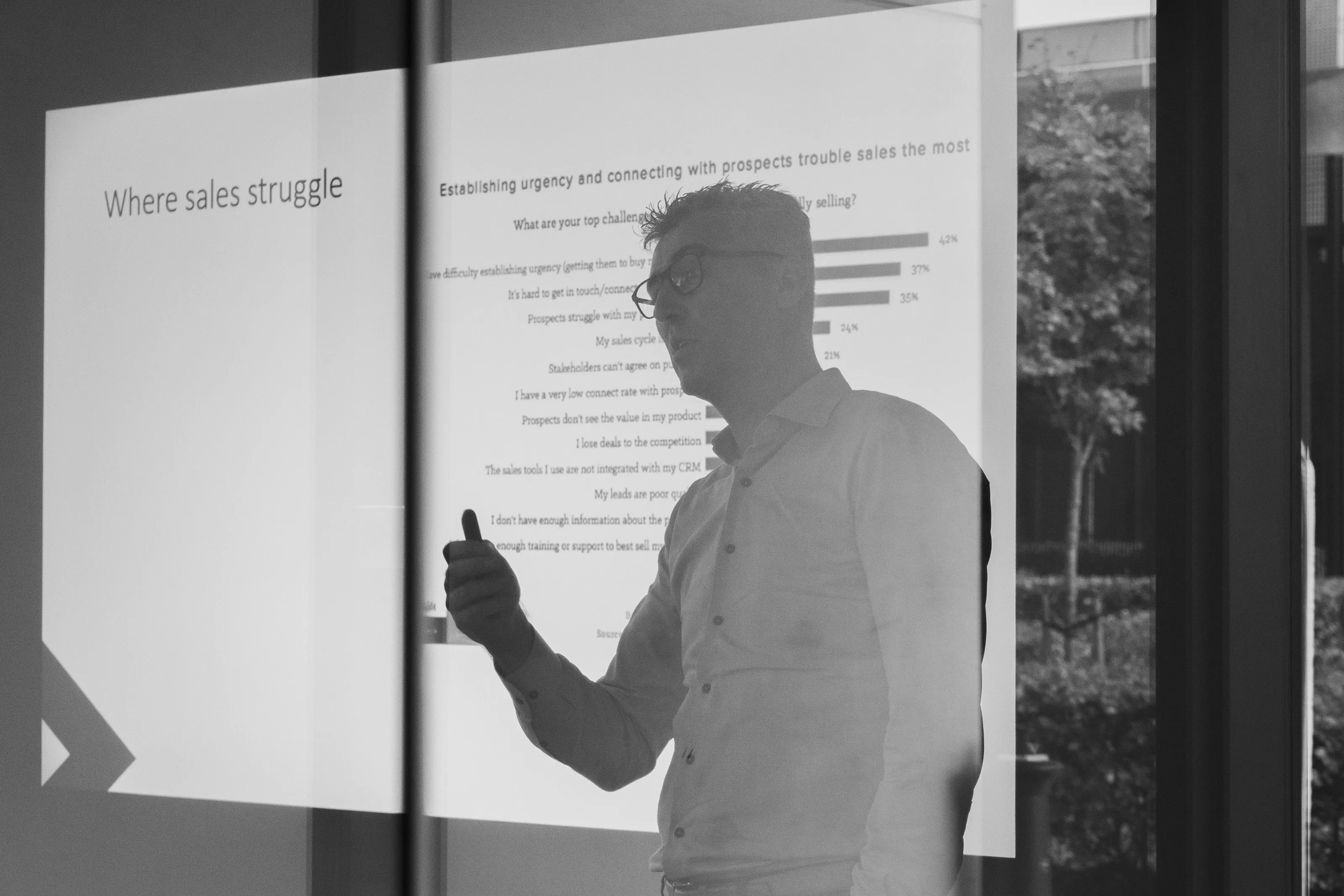
An employee assessment rarely measures only the employee. Above all, it measures what they are allowed to decide in your organisation.
Our instruments go beyond a questionnaire: psychometric rigour, read with the context alongside. That is why we never report a score without the role next to it. If someone scores low on initiative, the first question is not whether they can, but whether they were ever allowed to. Measuring ownership is only useful when you can hang a structural decision on it.
Four steps, and the third is the work.
Anyone can send out a questionnaire. The difference lies in scoring and interpretation: who reads what the numbers say about your organisation, and who dares to say what they don't.
of Belgian companies measure engagement more than once a year
Those that do score markedly better on wellbeing, culture and retention.
Edenred Belgium, 2025
Most organisations look once a year at most. An assessment only becomes an instrument when you repeat it and set it against your own previous measurement.
Measure organisation-wide with the scanSharpening the question
A conversation about scope, context and what you want to do with the outcome. We choose the instrument to fit that, not the other way round.
Administration with your group
Digital administration with the group you designate: one individual, one team or all managers together.
Analysis and scoring
Our certified assessment specialists score and interpret the results. This is where raw data becomes a readable pattern, and this is where the craft lies.
Feedback
A report that links quantitative benchmarks to qualitative insight, with development recommendations ranked by impact.
“My people will experience this as an exam.”
That is why everyone receives their own result first. What goes to the leadership team is the pattern across the group, not one person's score.
“We've already had a personality test done.”
That tells you something about preferences. We measure behaviour in context: what someone does at the moment nobody takes it off their hands.
“What if it turns out someone isn't in the right place?”
Then you know it with arguments instead of a suspicion. In most cases, incidentally, the problem lies in the role, not the person.
“We're too small for this kind of instrument.”
Whether a team assessment is statistically usable at your group size is something we look at in the introductory conversation. If it isn't, a conversation is more honest, and we will say so.
What managers put to us here.
Rightly, mostly. An assessment touches your people's careers, so the question should be sharp. These are the four we hear most often, and what we answer.
Book a conversation
Who gains from a team assessment.
Not everyone. If you are looking for material to support a dismissal case, we are the wrong party. If it concerns one person and you already know what is going on, coaching is faster and cheaper.
Leadership teams who want to know where ownership gets stuck collectively
HR leaders who want to target their development budget instead of spreading it
Coaches and consultants who want a validated starting point for a client engagement
Organisations that want to compare ownership across departments or sites
Digital
Follows from the first conversation
Checked per group
Certified specialists
What would an assessment uncover in your organisation?
Describe the decision about people or teams that is on the table. Sometimes a scan across the whole organisation makes more sense than an assessment per team. We will tell you that honestly too.